Why Agent Memory Needs a Delete Button
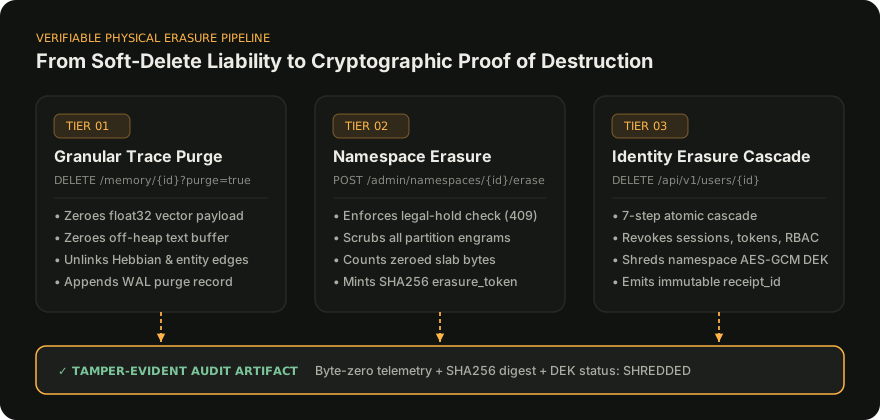
Why unbounded context accumulation creates data governance liabilities, and how active forgetting, byte zeroization, and cryptographic erasure receipts make long-term agent memory compliant and safe.
Engineering insights, architecture deep-dives, and technical analysis on long-term agent memory, data governance, and verifiable physical erasure.
Why unbounded context accumulation creates data governance liabilities, and how active forgetting, byte zeroization, and cryptographic erasure receipts make long-term agent memory compliant and safe.
Why the AI agent ecosystem currently uses “dreaming” for two distinct mechanisms—offline transcript consolidation and generative hypothesis construction—and why our experimental Dream pathway enforces strict source honesty.
A look ahead at why we plan to explore attractor-style Hopfield associative memory in ebbmem to complement store-and-retrieve indexing on partial cues—and the strict isolation, decay, and erasure invariants any future design must satisfy.
A technical tour of the cognitive signals specified on every trace in Memory Fundamentals (importance, retrieval strength D, storage strength S, valence, arousal, and open-loop state) and why closed provenance tags prevent agent confabulation.
Why classifying agent memory by storage topology misses the point, and how the open Memory Fundamentals specification (MF-001) defines a recall algebra, normal forms, and conformance rules for memory engines.
Eliminating external language models from the memory write path using local zero-shot ONNX models, FastEmbed, and deterministic civil date resolution to build sovereign, cost-predictable agent memory.