1. The Append-Only Trap of Modern AI Agents
Autonomous AI agents need persistent context across extended interactions. Remembering past conversations and preferences saves users from repeating instructions on every turn.
Many current architectures treat agent memory as an append-only sink. Every conversational turn and tool observation is embedded and inserted into a vector store or document table, continuously added but rarely removed.
Unbounded accumulation creates two primary operational hazards:
- Context Pollution: Transient tool outputs and superseded preferences accumulate alongside enduring facts. Semantic search retrieves stale or contradictory records, introducing noise into model prompts and degrading answer quality.
- Data Governance Liabilities: Retaining interactions indefinitely creates compliance and security exposure. Memory stores capture personal details, corporate secrets, and credentials that become vulnerable to prompt injection or unauthorized exfiltration.
In systems engineering, unbounded accumulation is an anti-pattern: caches expire, operating systems reclaim pages, and databases rotate logs. Long-term agent memory requires that same engineering discipline: the ability to actively prune, decay, and verifiably delete stored context.
2. Forgetting as an Active Engineering Feature
Effective memory management requires active destruction. Systems degrade without relevance decay and pruning; as observation counts grow, search thresholds lose selectivity, increasing irrelevant retrievals.
To maintain context precision, memory architectures rely on four operational mechanisms:
- Relevance Decay: Stored observations receive baseline retrievability scores that decline over time when unreferenced, prioritizing active context during retrieval.
- Habituation Curves: Repeated identical inputs attenuate rather than inflate retrieval priority, preventing redundant observations from saturating search indices.
- Fact Consolidation: Observations verified across multiple episodes transition into stable semantic storage, preserving critical user preferences across sessions.
- Active Data Pruning: Unused, faded observations are removed through automated compaction routines, reclaiming slab storage and maintaining low query latency.
Pruning and decay optimize day-to-day retrieval. However, when an individual or enterprise requests that data be erased, the system must execute permanent, verifiable deletion.
3. The Compliance Reality: Why Soft Deletes Fail Audits
Data privacy regulations place legally binding responsibilities on software architectures handling user data:
- GDPR Article 17 ("Right to Erasure"): Under Regulation (EU) 2016/679, data subjects have the right to obtain erasure of personal data without undue delay when consent is withdrawn or processing is no longer necessary.
- CCPA Deletion Requirements: Under California Civil Code Section 1798.105, consumers have the legal right to request the deletion of personal information collected by a business, requiring the business and its service providers to delete the data from their records.
In standard database systems, engineering teams often implement deletion by setting a boolean flag (deleted = true) or removing an index pointer. This soft-delete pattern fails compliance audits for three reasons:
- Data Remains on Storage Media: Setting a boolean flag leaves raw text and vector arrays intact on disk slabs, memory-mapped files, write-ahead logs, and backups. Reconstructible records on disk have not been erased under regulatory standards.
- Logical Filters Introduce Security Vulnerabilities: Relying on query-time filters (such as
WHERE deleted = false) creates operational risk. Indexing bugs, software regressions, or administrative bypasses can expose records marked as deleted. - Vector Embeddings Leak Sensitive Information: Dense vector embeddings can often be inverted or matched against reference datasets to reconstruct personal identities and conversational content.
While software cannot be certified compliant off the shelf (as compliance depends on organizational execution), infrastructure must provide genuine technical primitives that support right-to-erasure workflows.
4. Trust and Verifiability: Cryptographic Proof and Byte-Zeroing
Enterprise compliance officers and security teams cannot accept undocumented API confirmations. They require auditable, tamper-evident verification of permanent data destruction.
Verifiable agent memory erasure relies on three architectural pillars:
- Physical Byte Zeroization: Deletion routines must overwrite vector float payloads and off-heap text buffers with zeros, unlink relational graph edges, splice temporal chains, and record an explicit write-ahead log purge event.
- Deterministic Cryptographic Receipts: Administrative and account erasures must return tamper-evident cryptographic tokens. By computing an immutable SHA256 digest across the tenant identifier, namespace identifier, epoch timestamp, caller identity, and erased record count, the system provides a reproducible audit artifact.
- Cryptographic Shredding via Key Destruction: In multi-tenant systems using per-namespace envelope encryption (such as AES-256-GCM), each namespace is protected by a unique Data Encryption Key (DEK). Revoking the customer-managed master key or destroying the DEK renders all associated on-disk ciphertext unreadable without rewriting underlying storage slabs.
5. Walkthrough: Erase Maria, Get a Receipt
Consider an illustrative scenario with an enterprise customer support agent. A customer named Maria Garcia closes her account and submits a formal right-to-erasure request under GDPR Article 17.
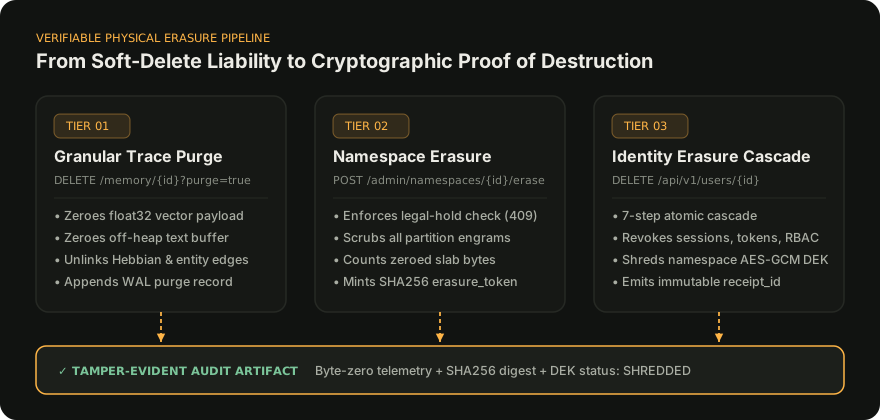
ebbmem executes erasure across three distinct operational tiers:
Tier 1: Granular Memory Trace Purge
When an agent removes a specific observation, such as a temporary address or outdated preference, it invokes the physical purge endpoint:
DELETE /api/v1/memory/9f8c4e2a-1b3d-4e5f-9a8b-7c6d5e4f3a2b?purge=true HTTP/1.1
Host: ebbmem.internal:8320
X-Ebb-Namespace: customer-support-prod
When purge=true is set, the engine overwrites vector float payloads and off-heap text buffers with zeros, unlinks associative graph edges, and logs a write-ahead purge record.
The endpoint returns a structured response:
{
  "memory_id": "9f8c4e2a-1b3d-4e5f-9a8b-7c6d5e4f3a2b",
  "namespace_id": "customer-support-prod",
  "found": true,
  "purged_at_ms": 1730229600000,
  "payload_bytes_zeroed": 1536,
  "text_bytes_zeroed": 284,
  "inline_text_dropped": true,
  "hebbian_edges_removed": 3,
  "temporal_unlinked": true,
  "entity_links_removed": 2,
  "hyperedges_removed": 1,
  "wal_recorded": true,
  "retained_header_fields": [
    "purged_at_ms"
  ],
  "unreachable_copies": 0,
  "disclosure": "Physical zeroing completed in compliance with storage erasure specification."
}
The response confirms physical zeroing telemetry, unlinked references, and write-ahead log confirmation.
Tier 2: Administrative Namespace Erasure
When an administrator purges a dedicated namespace partition:
POST /api/v1/admin/namespaces/ns-maria-garcia/erase HTTP/1.1
Host: ebbmem.internal:8321
Authorization: Bearer <admin-token>
The engine first checks for active legal holds. If present, the operation halts immediately with HTTP 409 Conflict, protecting records subject to ongoing litigation.
If no hold is active, memory traces within the namespace are physically scrubbed, and the server generates an audit response:
{
  "namespace_id": "ns-maria-garcia",
  "tenant_id": "tenant-acme-corp",
  "status": "erased",
  "engrams_erased": 42,
  "bytes_scrubbed": 68412,
  "erasure_token": "a4f8d6e9b2c17405e3f8190d7c2b5e4a19f8e3d2c7b5a8e104f9c3b7a5d1e2f8",
  "erased_at_ms": 1730229615000,
  "erased_by": "admin-sarah"
}
The returned erasure_token is a deterministic SHA256 digest computed across the tenant identifier, namespace identifier, timestamp, operator identity, and erased record count, giving the organization a verifiable, tamper-evident audit receipt.
Tier 3: Complete User Identity Erasure Cascade
When Maria Garcia requests complete account erasure, the platform invokes the user cascade:
DELETE /api/v1/users/usr_maria_garcia HTTP/1.1
Host: ebbmem.internal:8321
Authorization: Bearer <admin-token>
The system executes an atomic seven-step deletion cascade:
- Legal Hold Check: Verifies that neither the user nor the tenant is under an active legal hold.
- Identity Provider Removal: Unlinks federated authentication credentials from external identity providers.
- Session Invalidation: Terminates active sessions, invalidates refresh tokens, and purges credentials.
- Identity Purge: Removes user identity mappings from internal tables.
- Permission Revocation: Revokes role-based access control assignments and access grants.
- Cryptographic Shredding: Destroys the personal namespace Data Encryption Key (DEK), marking the namespace status as shredded.
- Audit Record Creation: Writes an immutable audit log entry documenting the completed cascade.
Upon completion, the endpoint issues an auditable receipt:
{
  "receipt_id": "rcpt_erasure_usr_mari_1730229620",
  "erased_at": "2026-10-29T19:20:20Z",
  "target_user_id": "usr_maria_garcia",
  "status": "COMPLETED",
  "purged_components": {
    "identities": 1,
    "credentials": 2,
    "sessions": 4,
    "tokens": 3,
    "grants": 2
  },
  "shredded_namespaces": [
    "p-usr_maria_garcia:default"
  ],
  "external_processors": {
    "auth_provider": "Identity provider account UID unlinked and deleted",
    "memory_engine": "Personal namespace DEK cryptographically shredded; key status marked SHREDDED"
  }
}
The organization can deliver this receipt identifier directly to the user or compliance auditors as auditable confirmation of permanent destruction.
6. Conclusion: Active Memory Management as an Enterprise Prerequisite
Autonomous agents cannot transition to production enterprise systems without rigorous data governance. While persistent memory allows agents to deliver personalized assistance, unbounded data accumulation introduces severe operational and legal risks.
Treating forgetting as an active engineering discipline, combining relevance decay, physical byte zeroization, customer-managed envelope encryption, and verifiable cryptographic receipts, provides the control plane for long-term agent memory.
By providing verifiable deletion primitives, agent platforms maintain context precision, respect statutory user privacy, and satisfy enterprise governance requirements.