Ask five engineering teams what powers their AI agent's memory, and you will usually hear five descriptions of storage plumbing: "a vector index plus an extraction prompt," "a property graph synced with embeddings," "editable markdown blocks in the harness," or "Postgres plus Qdrant plus Redis."
All of those are useful storage and orchestration patterns. None of them defines memory.
Before Edgar Codd published the relational model in 1970, data systems were similarly described by their physical access paths—pointer chains, hierarchical trees, and file layouts. Codd separated the logical contract (relations, a closed algebra, and integrity rules) from physical storage independence.
Memory Fundamentals (MF-001, licensed under CC BY 4.0) is Spectrayan's open specification applying that same architectural discipline to persistent AI agents. To be clear upfront: Memory Fundamentals is an open technical specification we published to invite scrutiny, counterexamples, and shared vocabulary—not an external standards-body mandate. Its goal is simple: state clearly what a machine must do to reconstruct a usable past, so claims about "agent memory" can actually be tested.
1. The Founding Distinction: Storage vs. Reconstruction
MF-001 opens with a single founding distinction:
"A database returns what was written. A memory engine reconstructs what is reachable from a cue at this moment — under decay, association, and tier physics — without losing a live trace because the first index was the wrong one."
When an application queries a database, a record either matches a predicate or does not; reading a row does not change its future durability, and time passing does not alter its rank unless you write an explicit timestamp filter.
An autonomous agent operating across months faces a different problem. Thousands of transient tool outputs, half-finished tasks, casual remarks, and critical user invariants accumulate inside the same history. What is relevant right now depends simultaneously on semantic and lexical match, encoding salience (I), current accessibility (D), durable encoding strength (S), emotional coloring (valence and arousal), multi-hop associations, and tier physics.
Therefore, the identity of a memory engine is its recall algebra, not its storage topology. Whether an implementation uses off-heap memory-mapped slabs, quantized vectors, or custom compressed graphs is physical design—not the definition of memory.
2. Why Single-Signal Top-k Fails: The Truncation Trap (M2)
To see why storage-first compositions fail in subtle ways, consider the worked example in MF-001 §3:
- Three years ago, a user stated with high importance and strongly negative valence: "Never book red-eyes."
- Last week, the same user joked casually about cheap overnight flights.
- Today, a cue arrives: "Book my flight to London."
Most RAG-style memory stacks execute a two-stage retrieval plan: pull the cosine top-100 chunks from a vector index, then re-rank those 100 candidates by recency or importance.
On "Book my flight to London," the three-year-old constraint ("Never book red-eyes") is old, lexically distant from "London," and sits outside the top-100 cosine neighborhood—crowded out by recent travel chatter and last week's joke. Because it never enters the candidate set, no downstream re-ranker or LLM prompt can recover it.
MF-001 calls this miss the truncation trap, and Conformance Rule M2 (Guaranteed Access) forbids single-signal candidate generation as the sole generator. If a trace is available (not erased) and passes a cue's binary hard gates (such as namespace, tier mask, required tags, or an explicit valence/time window), no retrieval plan may discard it before all first-class signals have participated in fused scoring.
3. A Closed Recall Algebra: Required vs. Optional Verbs
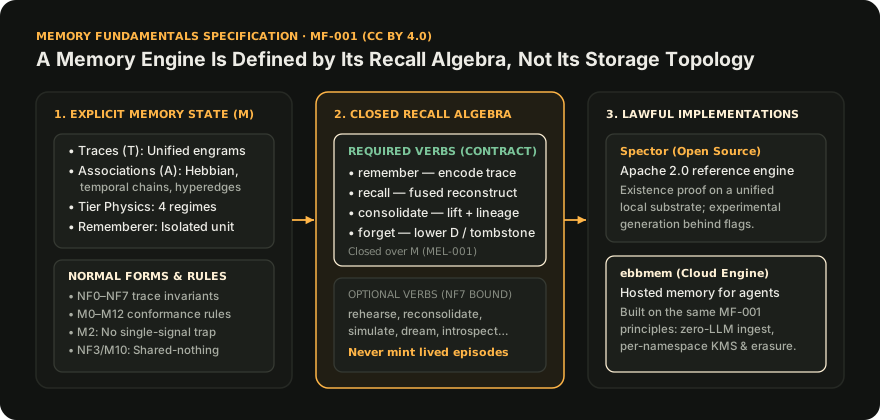
In MF-001 §5 (and its companion BNF grammar, MEL-001), operations are closed over an explicit memory state M comprising traces, associations (Hebbian co-activation, temporal chains, and multi-entity hyperedges), tier physics (working, episodic, semantic, procedural), per-trace strength/flags, and an isolated rememberer boundary. If the caller has to query a vector store, query a separate graph database, and stitch the results together in application code, the algebra is not closed (violating Rules M0, M1, and M11).
MF-001 v1.0.1 separates the algebra into four required conformance operations and ten optional operations:
| Category | Algebra Operations | Role in the Memory Contract |
|---|---|---|
| Required for conformance | remember, recall, consolidate, forget |
Encode traces into tiers; reconstruct fused rankings from a cue (updating D); lift episodic traces into semantic/procedural knowledge with lineage; weaken accessibility or tombstone |
| Optional strength & structure | rehearse, reconsolidate, associate, inhibit, reinforce, project_tier, introspect |
Update D/S without returning payload; rewrite payload with preserved lineage (NF5); manage native associations, habituation, outcome valence, tier projection, and observability (M12) |
Optional generation (NF7-bound) |
simulate, dream, commit_simulation |
Offline replay, counterfactual probing, and controlled promotion to distilled—never minting experienced autobiography |
Making simulate and dream optional—while strictly binding them to Normal Form 7 (NF7 — Source Honesty) whenever they are implemented—keeps the core contract lean without leaving generative extensions ungoverned. We unpack that distinction in detail in Two Kinds of “Dreaming” in Agent Memory.
4. Normal Forms (NF0–NF7) and Conformance Rules (M0–M12)
Taxonomies and surveys (such as CoALA in Sumers et al., 2023/24, alongside classical cognitive architectures like ACT-R and Soar and Bjork & Bjork's 1992 disuse theory) organize how we talk about agent cognition. What MF-001 adds is disqualifying engineering constraints—normal forms (NF0–NF7) and twelve conformance rules (M0–M12) that grade mechanisms rather than marketing labels:
- Single Engram Unity (
NF0,M1): Vector representation, text payload, cognitive header, and graph incidence are faces of one trace identity. Two stores that can disagree about whether a memory exists failNF0. - Lineage of Distillation (
NF2,M8): Every semantic or procedural trace produced byconsolidatepreserves lineage back to the episodes it distilled. - Shared-Nothing Rememberer Isolation (
NF3,M10): Traces, associations, and logs of Rememberer A and Rememberer B must never share an authoritative table, index, or collection where isolation depends on a query planner rememberingWHERE rememberer = 'A'. Separate storage trees or separate cryptographic domains satisfyNF3; row-level predicates on a shared index do not. - Specified Forgetting & Observability (
M7,M12): A store that never decays failsM7. And throughintrospect(andEXPLAIN RECALLinMEL-001), an engine must be able to explain why an available trace was inaccessible to a given cue.
Just as importantly, MF-001 is candid about what remains open (§11), including whether the specification should standardize a multiplicative vs. additive fusion family, the cheapest sub-linear plans that provably avoid the M2 truncation trap at large scale, and the minimal portable format for M8 lineage records.
5. How Memory Fundamentals Connects to Spector and ebbmem
Across Spectrayan, the specification and our two engines play distinct, complementary roles:
- Memory Fundamentals (CC BY 4.0) is the public model, recall algebra (
MEL-001), normal forms, and conformance test blueprint. - Spector (Apache 2.0) is the open-source memory engine—cited in
MF-001as an existence proof that unified engrams, four-tier physics, native Hebbian/temporal/hyperedge associations, and fused scoring run on a single substrate without external databases. - ebbmem is our cloud memory engine, built on the same principles for teams that want hosted MCP and HTTP memory with zero-LLM local extraction (Memory Without an LLM in the Loop), per-namespace envelope encryption, and verifiable cryptographic erasure (Why Agent Memory Needs a Delete Button).
Read the full MF-001 specification on GitHub, inspect the test fixtures, and challenge any rule you think can be broken—because a specification that cannot be tested in public is not a specification.