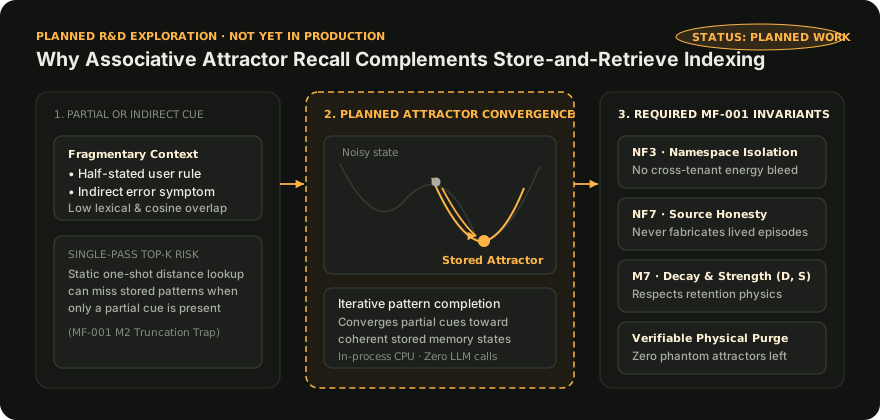
Most production agent memory systems—even sophisticated ones—operate on a single-pass store-and-retrieve mental model. When an observation arrives, the engine encodes text, entities, cognitive signals, and embeddings; when a query arrives, the engine scores stored records against the query in one forward pass and returns the highest-ranking traces.
Single-pass fused scoring solves a large share of long-term agent memory problems, especially when combined with local deterministic extraction, continuous retention decay, and co-activation edges. Yet there is a specific class of recall problems where human associative memory behaves qualitatively differently from a one-shot index lookup: reconstructing a coherent memory from a fragmentary, degraded, or indirect cue.
In this post, we want to share openly what we plan to explore and implement next around Hopfield-style associative and attractor recall—why the problem matters for real agents, what associative dynamics offer conceptually, and the non-negotiable engineering invariants any implementation in ebbmem will have to pass before shipping.
1. Where One-Shot Similarity Runs Thin: Partial and Degraded Cues
In clean benchmark prompts, retrieval queries often resemble search-engine inputs: "What unit system does the user prefer for itinerary distances?" Both lexical matching and dense vector embeddings handle direct questions well because the cue already sits close to the target trace in representation space.
Live autonomous workflows rarely hand the memory engine such tidy cues. Instead, an agent encounters partial or oblique fragments:
- Symptom-first debugging: An infrastructure agent observes a subtle latency spike on a downstream queue—only one fragment of a multi-service failure pattern encountered four months earlier under different hostnames.
- Implicit situational constraints: A user says "Set up the Thursday partner review the usual way," where "the usual way" binds together five separate traces (calendar buffer preferences, slide formatting rules, attendee exclusions, and security redaction habits) none of which share high pairwise cosine similarity with the words "Thursday partner review."
- Compound cues with low per-axis overlap: In Memory Fundamentals (MF-001), Rule
M2highlights the truncation trap: candidate generation driven by a single similarity signal routinely drops older, high-importance constraints whose surface wording diverges from the immediate prompt.
Fused multi-signal scoring (combining semantic similarity, lexical overlap, importance, retrieval and storage strength, valence, tags, and graph associations) directly addresses single-signal truncation. Even with multi-signal fusion, however, a single-step lookup evaluates the cue as given. If the cue itself is missing half its features, the query vector starts out sitting in the middle of representation space between several weak matches rather than snapping onto the underlying stored pattern.
2. Why Associative / Attractor-Style Memory Is a Compelling Complement
In computational neuroscience and machine learning, content-addressable associative networks—originating with John Hopfield's classical associative models (1982) and modernized through dense, continuous-state Hopfield formulations (such as Krotov & Hopfield, 2016; Ramsauer et al., 2020)—frame recall not as a static nearest-neighbor table scan, but as iterative convergence over an energy landscape.
At a high level, stored memory patterns define low-energy attractor basins:
- Pattern completion from partial cues: When a degraded or partial cue enters the network, iterative updates move the state vector downhill toward the nearest stable attractor basin. A noisy fragment doesn't just return a low-confidence similarity score; it reconstructs the fuller stored pattern so downstream ranking can lock onto the right trace or cluster.
- Separating close competitors: Classical binary Hopfield networks suffered from severe capacity limits and spurious mixed states when patterns correlated. Modern continuous-state formulations sharply increase storage capacity and allow controllable inverse-temperature scaling—capable either of settling cleanly onto a single sharp memory prototype or blending closely related context when appropriate.
- Complementing—not replacing—engram storage: We do not view a Hopfield layer as a replacement for explicit memory traces, structured provenance, or multi-signal fusion. An attractor step is valuable as a cue-refinement and pattern-completion mechanism operating alongside the authoritative trace store—helping a partial cue reach the right engrams without discarding exact text, timestamps, or lineage.
| Retrieval Regime | Strengths | Limitation Addressed by Planned Exploration |
|---|---|---|
| Single-signal vector top-k | Fast approximate nearest-neighbor lookup on clean semantic paraphrases | Vulnerable to the MF-001 M2 truncation trap; ignores salience, decay, and multi-hop structure |
| Fused multi-signal recall (current core) | Integrates similarity, importance (I), strength (D, S), valence, tags, and graph edges in one closed pass | Evaluates the cue in a single step; heavily fragmentary cues may remain equidistant from target clusters |
| Planned attractor-assisted recall | Iteratively completes partial or noisy cues toward stored memory basins before or during fused reconstruction | Must be engineered carefully to stay fast on CPU, strictly isolated per namespace, and physically erasable |
3. Non-Negotiable Constraints Before Anything Ships in ebbmem
Exploring an idea in research literature is easy; earning a place inside a multi-tenant cloud memory engine is much harder. Spector is our open-source memory engine where cognitive mechanisms can be prototyped and scrutinized in the open, while ebbmem is our cloud memory engine built on the same principles.
Before any Hopfield-style or dense associative mechanism becomes part of ebbmem, our planned design has to satisfy four hard architectural requirements:
A. Zero-LLM, Bounded-Latency CPU Execution
As we wrote in Memory Without an LLM in the Loop, ebbmem eliminates external language models from the default memory path so latency, cost, and data residency stay predictable. Any associative convergence step must run in-process on standard CPU hardware within a tight, bounded iteration budget—never relying on generative prompt loops to "guess" missing cues.
B. Strict Shared-Nothing Namespace Isolation (NF3 / M10)
In a naive shared associative matrix, storing patterns from multiple users or tenants in the same energy function would be catastrophic: a partial cue from Tenant A could converge toward an attractor shaped by Tenant B's vectors. Under Memory Fundamentals Normal Form NF3 and Rule M10, every rememberer (namespace) is an isolated persistence and cryptographic boundary. Any associative state must be scoped strictly within a single namespace and sealed under that namespace's encryption boundary.
C. Verifiable Erasure Without “Phantom Attractors”
This is one of the sharpest engineering challenges in associative memory. In distributed weight matrices, "unlearning" a single stored pattern without leaving residual energy wells—or rebuilding the entire structure—is notoriously tricky. As covered in Why Agent Memory Needs a Delete Button, ebbmem treats physical deletion (DELETE /api/v1/memory/{id}?purge=true and namespace cryptographic shredding) as a hard governance guarantee. If a trace is purged, zero reconstructible trace of its vector or associations may survive in any auxiliary associative structure.
D. Source Honesty (NF7) and Retention Physics (M7)
Pattern completion must help a cue locate real stored traces—never invent synthetic facts and pass them off as experienced episodic memories (NF7). Likewise, attractor weights must respect trace accessibility (D) and tombstones so faded or forgotten noise does not pull active cues into stale basins.
4. How We Will Judge Whether It Earns Its Keep
We are deliberately sharing this at the plan stage rather than waiting to present a finished victory lap—and we want to be equally candid about how we will evaluate it.
A new associative mechanism does not belong in the default path simply because the mathematics are elegant. As we implement and test this work, we intend to evaluate candidate designs against strong, non-Hopfield baselines (including ebbmem's existing fused hybrid and Hebbian graph traversal) on targeted partial-cue, noisy-cue, and truncation-trap workloads, measuring:
- Recall lift on degraded cues versus standard single-pass fused retrieval,
- False-attraction / over-completion rates when no stored memory actually matches the cue,
- CPU latency, memory footprint, and exact purge cost under realistic churn.
Where an associative attractor layer proves measurably better within those constraints, we will ship it alongside transparent benchmarks and protocol disclosures. Where a simpler mechanism performs just as well, we will say that plainly too. If you are working on associative recall, partial-cue benchmarks, or conformance tests in Memory Fundamentals, we welcome critique and counterexamples.