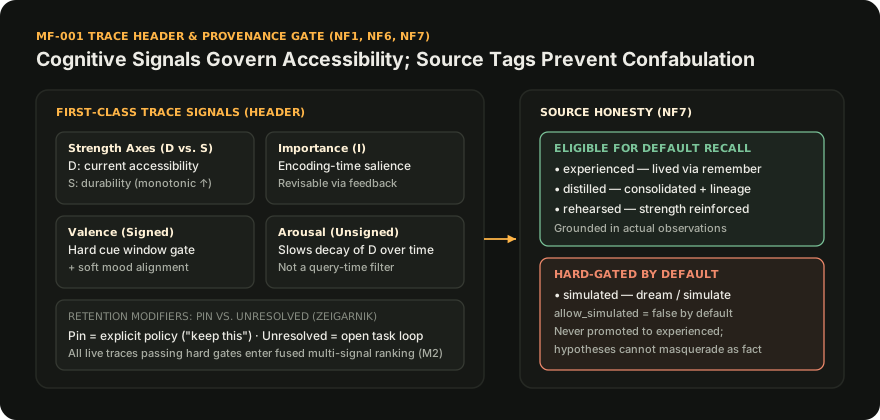
When an AI agent stores context in a conventional vector collection, every record looks structurally identical: an ID, a text chunk, a dense float[] vector, and perhaps a JSON blob of unindexed metadata.
That flat schema forces a single similarity number to do five incompatible jobs at once: judge whether a statement was crucial or trivial, track whether it is still fresh or long superseded, separate failures from successes, hold open unfinished tasks, and distinguish something the user actually said from something the agent guessed three sessions ago.
In the Memory Fundamentals specification (MF-001)—which underpins both our open-source memory engine Spector and our cloud memory engine ebbmem—those dimensions are not optional application metadata. Under Normal Form 1 (NF1 — Header Completeness) and Rule M3 (Signal Integrity), every signal that can change recall lives directly on the trace header and is consulted on the retrieval path.
Let's open up that trace header and examine what each cognitive parameter actually computes—and why the source tag is the difference between a reliable agent and a confabulating one.
1. Two Axes of Strength: Retrieval Strength (D) vs. Storage Strength (S)
Databases have a binary notion of existence: a row is either present or deleted. Following Robert and Elizabeth Bjork's New Theory of Disuse (1992), MF-001 separates availability (whether a trace still exists and has not been tombstoned) from accessibility (whether the current cue can reach it inside budget k), using two distinct strength parameters:
- Retrieval strength (D): Current accessibility in
(0, 1]. D decays over time with disuse and rises whenever a trace is recalled (M9) or rehearsed. Usually, "forgetting" is loss of D—the trace has not been erased, it has simply yielded working priority to more active context. - Storage strength (S): Encoding durability (
S ≥ 1). S is monotonically non-decreasing except on tombstone. Callingforgetlowers D and never lowers S. High S protects a well-learned fact by slowing future loss of D.
Splitting D from S also captures desirable difficulty: in MF-001 §4.5, rehearsing a trace when its current retrieval strength D is low produces a larger storage-strength gain (ΔS = s_gain · (1 − D)) than repeating the same fact ten times inside thirty seconds. Spaced use across real sessions builds durable knowledge (S↑); rapid-fire repetition does not.
2. Importance (I), Valence, and Arousal: Distinct Jobs, Not Synonyms
On POST /api/v1/memory/remember in ebbmem's API (and in Spector's ingestion pipeline), callers can supply importance, valence, and arousal—or allow the engine to derive them at encoding time (NF6, which requires defined valence, arousal, and importance on every episodic, semantic, and procedural trace while exempting volatile working-tier scratchpads).
Each of the three parameters has a distinct mathematical role in MF-001:
| Parameter | Domain & Sign | Exact Role in MF-001 |
Example in an Agent Workflow |
|---|---|---|---|
| Importance (I) | Positive scalar | Encoding-time salience (revisable later via feedback). Weights fused ranking alongside D and S. | A user's hard security constraint or allergy (importance: 0.9) vs. routine status chatter (0.1). |
| Valence | Signed (negative ↔ positive) | Dual role: hard gate when a cue sets a valence-window, plus soft alignment inside that window. |
Querying negative-valence memories ("What broke during the last deploy?") vs. positive ones ("Which rollout strategy succeeded?"). |
| Arousal | Unsigned intensity | Modulates the decay law for D (high arousal slows decline of D). Never a query-time cue filter. | An acute production outage (high arousal) decays much more slowly over weeks than a routine health check of equal age. |
In Spector, you can see how compact physical realizations of these signals can be: valence occupies a single signed byte (-128 to +127) checked in a couple of CPU cycles before vector math runs, while adaptive novelty detection scores spatial and temporal surprise to initialize importance without calling an external LLM.
3. Pin vs. Unresolved: Policy Is Not Task State
Real agents also need certain traces to resist decay temporarily or permanently. MF-001 §4.1 explicitly separates two flags that implementations often conflate:
pin(Retention policy): An explicit directive ("keep this invariant accessible"), such as an organizational compliance rule or standing persona instruction.unresolved(Task state — the Zeigarnik effect): An open loop—a pending follow-up, an unanswered diagnostic hypothesis, or an unverified migration step. Under Conformance RuleM7, unresolved traces decay more slowly than resolved ones until the task closes, at which point normal decay resumes automatically without leaving permanent clutter pinned at the top of memory.
4. Source Honesty (NF7): Stopping Self-Reinforcing Hallucinations
Cognitive signals govern how strongly a trace competes during recall. Source honesty (NF7) governs what kind of epistemic claim a trace is allowed to make.
Consider what happens in a multi-session agent without provenance tracking:
- In Session 1, while troubleshooting a timeout, the agent writes an unverified hunch into memory: "Timeout is probably caused by legacy TLS 1.1 settings on the payment gateway."
- In Session 4, a retrieval query on "payment gateway configuration" returns that hunch right alongside verified infrastructure facts—with nothing in the schema distinguishing observation from speculation.
- The agent treats its own old guess as established history, acts on it, and writes a second summary reinforcing the error.
MF-001 closes this loophole with Normal Form 7 (NF7). Every durable trace carries a closed source tag with exactly four lawful values:
experienced— Created only byrememberfrom actual observations and user interactions. Episodic autobiography can only beexperienced.distilled— Created whenconsolidatelifts repeated or verified episodes into semantic or procedural knowledge (or whencommit_simulationexplicitly promotes a vetted insight), always carrying lineage (NF2/M8) pointing back to its source inputs.rehearsed— Traces whose retrieval and storage strengths (D, S) have been updated through spaced retrieval or rehearsal without fabricating new autobiographical events.simulated— Counterfactual hypotheses, thought experiments, or offline recombinations produced by optionalsimulateordreampathways (taggedDREAMED,THOUGHT_EXPERIMENT, orCONSTRUCTEDwithFLAG_DREAMED/FLAG_SIMULATEDin Spector).
Two strict invariants make NF7 teeth-bearing rather than advisory:
- No promotion to autobiography: No operation in the recall algebra—not
dream, notreconsolidate, notcommit_simulation—may ever convert asimulatedtrace into anexperiencedepisodic memory. - Hard-gated default recall: Every recall cue carries
allow_simulated, which defaults tofalse. Standard factual recall omitssimulatedtraces unconditionally; an agent only sees hypothetical or dreamed residue when it explicitly asks for hypotheses. (We explore how this works in practice in Two Kinds of “Dreaming” in Agent Memory.)
5. Practical Takeaway for Agent Architects
When evaluating or designing an agent memory layer, look past the vector index benchmark and inspect the trace header:
- Can the engine separate current accessibility (D) from long-term durability (S), or does every read and TTL treat a core preference the same as a transient log line?
- Are importance, valence, arousal, and open-loop state first-class signals in fused recall (
M2,M3), or inert JSON fields ignored until after cosine top-k has already dropped the trace you needed? - Does every trace record how it came to exist (
NF7), and if a user later exercises their right to deletion (Why Agent Memory Needs a Delete Button), can both the source episodes and theirdistilledderivatives be cleanly traced and erased?
Explore the full signal and provenance rules in Memory Fundamentals, inspect their open-source implementation in Spector, or try cognitive parameters on remember and recall in the ebbmem documentation.